
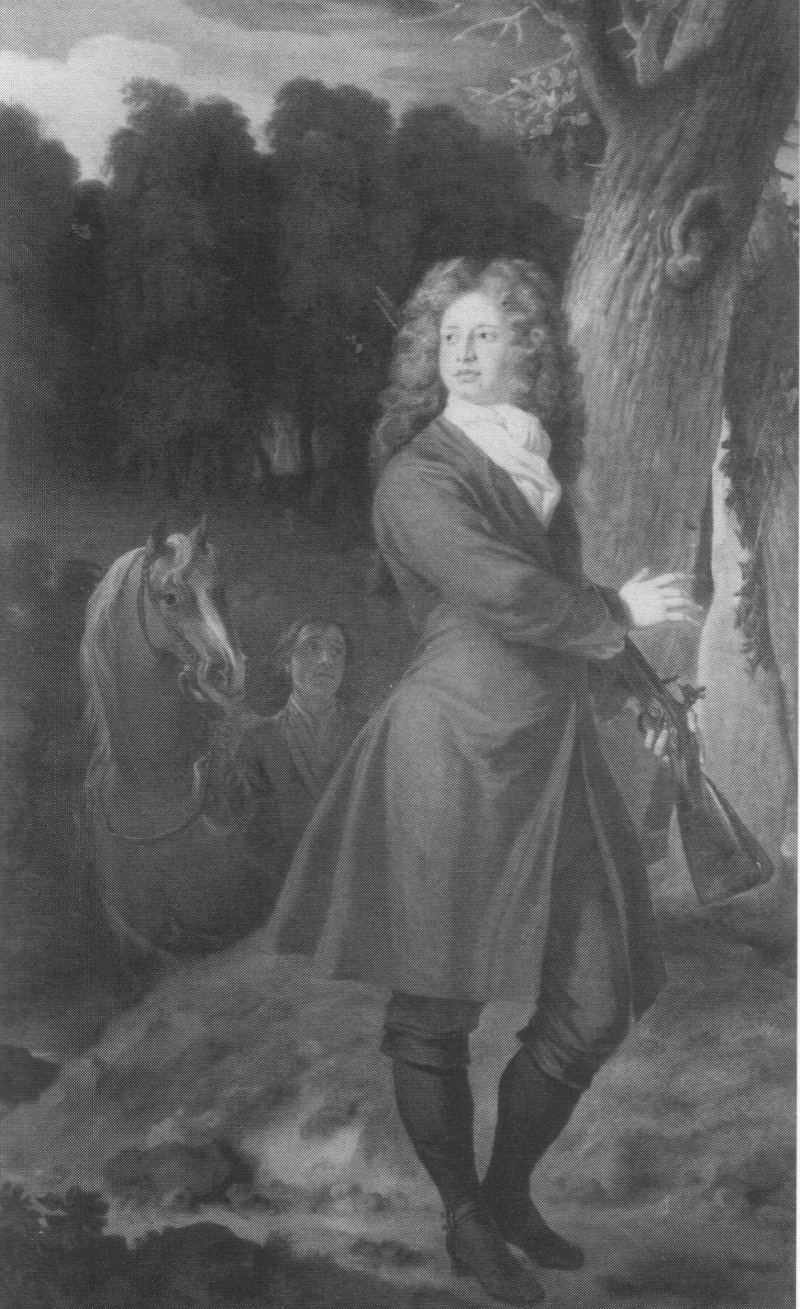
(courtesy of the Earl of Shaftesbury)
Maurice Ashley (1675-1726)
Returned between 1695 and 1713 as MP for, consecutively, Weymouth & Melcombe Regis, Wiltshire, Weymouth & Melcombe Regis, Shaftesbury’s younger brother remains best known for his translation of Xenophon’s fictional life of Cyrus:
Cyropædia: or, The Institution of Cyrus. By Xenophon. Translated from the Greek by the Late Honourable Maurice Ashley Esq; To Which is Prefixed, A Preface, by Way of Dedication, to the Right Honourable the Lady Elizabeth Harris, 2 vols. (London, 1728).
Published two years after his death, the translation saw five editions between 1728 and 1803 (the fifth was reissued in 1811 and 1816); it also appeared in Dublin (1728, 1785, 1798) and Philadelphia (1810). In 1830 it was printed together with E. Spelman’s translation of the Anabasis, and both texts were then included in the 1831 Whole Works, which was reprinted a number of times between 1832 and 1858 (in London, Glasgow, New York, and Philadelphia).
The preface is addressed to Maurice’s sister Elizabeth (1681-1743), the mother of James Harris:
I know the affectionate Concern you have for the Liberty of your Country; which you value that the Integrity and Simplicity of human Minds may be protected, and not over-born by tyrannical Impositions or debauch’d by Imposture; that they may be kept as the chaste Spouse of divine Truth; and that Innocence and Virtue may not be violated by the ungovern’d Passions of the Mighty; I know the Joy you ever express’d for your country’s Success in a just War. (51-2)
The themes include “real Religion”, which “can by no Means be disjoin’d from Morals” (1), as opposed to “established and political Religion” (8); “Man in the State of Nature” (11) — a rejection of Hobbes: “in the whole, it seems evident enough, that we are naturally a mild, gentle, sociable, and compassionate Creature” (17); Xenophon as a man of “great Modesty and Goodness of Temper […] of great Knowledge and Learning” which was “of an ingenuous, noble gentleman-like Sort, not sedantary, not pedantick, and not servile” (39) — a portrayal reminiscent of Shaftesbury’s admiration for Xenophon (cf. Chartae Socraticae); “Free-thinking” (ancient and modern), “Hobbists and the Favourers of Ecclesiastical Tyranny”(41 ff.). Cf. Clive Probyn, The Sociable Humanist: The Life and Works of James Harris 1709-1780 (Oxford, 1991), pp. 38-41: “Ashley’s preface is sternly anti-Hobbesian and rigourously anti-Epicurean”, his “argument is classic deism, offering a synthesis of metaphysical, social, and ethical arguments based on a benevolist view of human psychology”; “this is the most striking evidence of the seminal influence of the third earl’s philosophy on the Harris family.”
Manuscripts
The National Archives, Kew
TNA:PRO 30/24/27/27: The Picture by Cebes, Disciple of Socrates.
A translation of the Tabula Cebetis; text edited in SE I 5, 455-79.
TNA:PRO 30/24/29/94: Cyropædia, or the Institution of Cyrus by Xenophon.
A paper-bound book showing 328 pp. from Maurice Ashley’s Institution of Cyrus (Books 1-4 and the first few lines of Book 5).
TNA:PRO 30/24/29/97: “Mr Ashley’s translation of Homer” [Iliad 1,1-2,333].
A verse translation of Iliad Books 1-3 (108 pages);
Sing Goddess of the Rage of Peleus’ Son,
Destructive, & that brought ten thousand Griefs
On the Achæans, that dismiss’d brave Souls
Of Heroes crowding to the Shades, themselves,
[…]
Doe you the Argive Helen restore
And with herself her Fortune all and Pay
Th’Argives the Fine that’s Just & fair that this
To future Ages may remain. So spoke the Son
[…]
Hampshire Record Office, Winchester
Malmesbury Papers 9M73/G268, an unbound notebook with text on 207 numbered pages, apparently fair copies of the following translations:
“The Picture. By Cebes Disciple of Socrates” (same text as in the above-mentioned TNA: PRO 30/24/27/27).
Selected chapters from Arrian’s Discourses.
Homer, Iliad 1,1-2,333 (same text as in the above-mentioned TNA:PRO 30/24/29/97).
Malmesbury Papers 9M73/G278, a small, paper-bound notebook entitled “Select Original-Peices and Translations Written by the late Honourable Maurice Ashley Esq.”
Contents: “A Psalm or Hymn” (pp. 1-4); “Another” (pp. 5-8); “The Prayer of Cleanthes” (pp. 9-10); “Xenophon to Æschines” (pp. 11-12, now in SE II 5, 291-2). This document also includes two sheets folded to form eight pages, five of these with writing, the text an English version of Arrian, Discourses 1,28,1 ff.
Portraits
John Closterman, c. 1700/1: The third Earl and his brother as Greek philosophers (National Portrait Gallery, Beningbrough Hall). A detailed discussion can be found in the “Portraits” section.
John Closterman, c.1701/2: Maurice Ashley in hunting dress, in the background his horse and groom (above, Earl of Shaftesbury).