Workshops

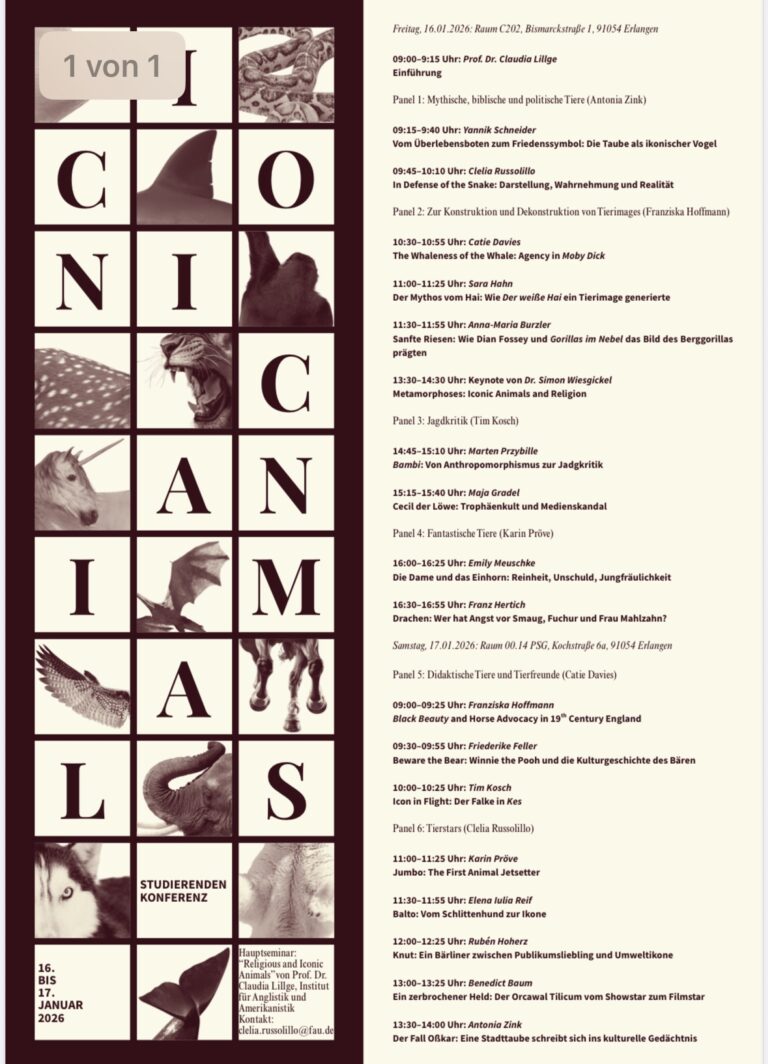
Animals are central to our lives. They are domesticated and used for clothing and food; incorporated into families as pets; hunted for subsistence and sport; deified in religions; and put on display in zoos and museums. This student conference focuses on iconic animals, i.e., animals with strong sy...

The Chair for English Cultural and Literary Studies is pleased to announce Jack Halberstam as this semester's Researcher in Residence. The Researcher in Residence is a format designed as an opportunity for students and staff alike to form connections with internationall...

In collaboration with the Research Training Group “Literature and the Public Sphere in Differentiated Contemporary Cultures”, the Institute for English and American Studies is pleased to announce that Professor Vivian Liska will be visiting us at FAU. The director of Jewish Studies at the University...

The Chair for English Cultural and Literary Studies is pleased to announce Henk de Berg as this semester’s Researcher in Residence. The Researcher in Residence is a format designed as an opportunity for students and staff alike to form connections with internationally renowned researchers. The idea is to go beyond the usual types of classes and to be able to get up close and personal with the researcher both on the topic(s) of their research but also their experience in academia in their field and their country. Henk de Berg will spend the week of July 8th through July 12th at FAU and host or participate in various teaching and discussion formats...

The seminar "Chinatowns and Little Indias" invites all interested students to an EXPERT LAB with Gisela Ecker. Based on the short story "Mrs. Sen's" from Jhumpa Lahiri's short story collection "Interpreter of Maladies" (2000), we will ask how things and food produce "locality" in contexts of de- ...

Venedig sei die unwahrscheinlichste der Städte, lesen wir in Thomas Manns berühmter Künstlernovelle Der Tod in Venedig (1912) eine Behauptung, die nach wie vor mit nicht allzu großem Widerspruch zu rechnen hat. Denn in der Tat: Die Serenissima ist eine städtebauliche Kuriosität sondergleichen, ihre Entstehung in den Fluten des adriatischen Meeres präsentiert sich dem gesunden menschlichen Verstand als irritierende Aberration. Vor allem deswegen fasziniert uns die Lagunenstadt, vor allem deswegen ist sie wie wohl kaum eine andere über die Jahrhunderte hinweg bereist, beschrieben, gemalt, fotografiert und auf Film gebannt worden.