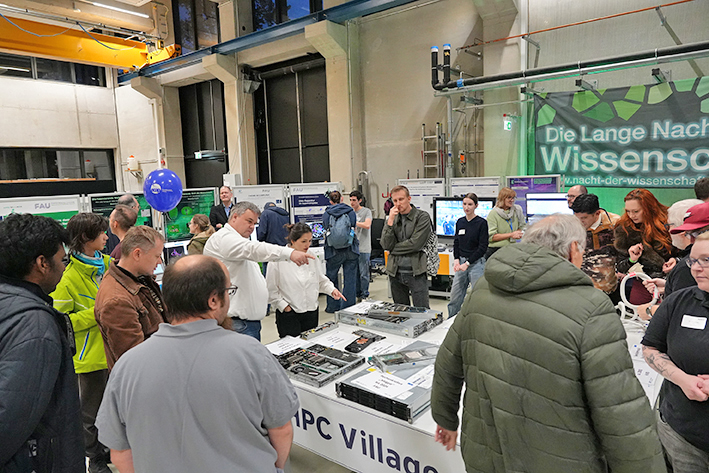
The first HPC Cafe for the Humanities and Social Sciences
18.03.2026
Your R code is taking too long? Your Python code runs out of memory? You have thousands of questions for a large language model (LLM)? If you answered ‘yes’ to at least one of these questions, welcome to High-Performance Computing (HPC). HPC is about the use of powerful computational systems to do computation and data processing at speed and scale far beyond the capabilities of a typical desktop computer or a laptop.
As part of a monthly series of HPC Café talks offered by the National High-Performance Computing Center at the FAU (NHR@FAU) – and for the first time at the PhilFak – Armine Garibyan, a liaison scientist at NHR@FAU, gave a hybrid talk on how researchers with a background in the Humanities or Social Sciences could get access to the HPC resources at the FAU. While these researchers were enjoying their coffee and cakes, Armine told them how using HPC resources at the FAU can make their research more efficient, explained what HPC is, how to get an HPC account and how to use these resources.
If you missed the talk, no worries! Both the recording as well as the slides are available at https://hpc.fau.de/teaching/hpc-cafe/

A new ERASMUS MUNDUS joint MA programme at the FAU – Data Science of Human Multimodal Communication
28.10.2025
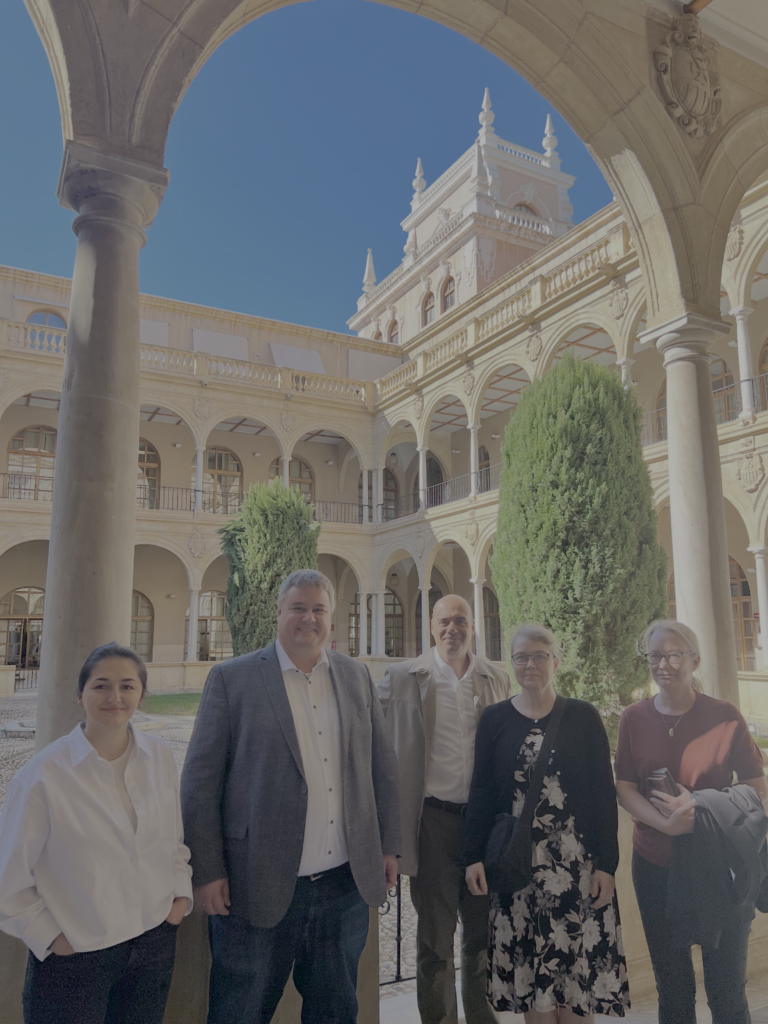
A new ERASMUS MUNDUS MA programme in Data Science of Human Multimodal Communication (MULTICOM) will start at three universities – the University of Murcia (Spain), Friedrich-Alexander-Universität Erlangen-Nürnberg (Germany), and Lund University (Sweden) – in the winter semester 2026/2027.
The programme focuses on the connection between language, thought, and different modalities of communicative behavior, including gesture, gaze, facial expression, pose, speech articulation, prosody, and more. It integrates humanities, multimodality, data science, and technology into its curriculum.
The Chair of Big Data Linguistics (led by Prof. Dr. Peter Uhrig) will organise and coordinate teaching and training activities during the semester at FAU. More information about MULTICOM can be found at https://multicom-em.eu
BDL at the Lange Nacht der Wissenschaften 2025
27.10.2025
Imagine you have a large corpus containing thousands of hours of video data. Wouldn’t it be exciting if we could automatically search for a specific gesture in this data? But how does a computer know what gesture we are looking for? One approach is to describe the gesture using “rules.”
For example, if we want to find all instances in which people make “air quotes” with both hands by moving their index and middle fingers, we could define these movements in terms of x and y coordinates – for instance, by specifying that the tips of the index and middle fingers must be above the tip of the thumb. By adding several such conditions, the target gesture can be described more precisely.
The Chair of Big Data Linguistics demonstrated this approach at the Lange Nacht der Wissenschaften 2025. Prof. Peter Uhrig, Armine Garibyan, and Johanna Gross showed how rule-based conditions can be used to automatically detect gestures and answered questions about the application. Visitors could see themselves on the screen and watch the application respond when they made “air quotes” with their hands.